
The discussion about property issues in Poland appear on several headlines recently. Due to the way they are portrayed, the one may get an impression, that the Poles spend the war sitting comfortably in looted Jewish armchairs, and sipping tea, proud of their new homes taken from Jews. This is further increased by claims that the Jews were held in Polish Concentration Camps, and that the Poles took active part in the destruction of the Jewish community. Is the perspective true?
When the Polish soldiers arrived to the Island of the Last Hope, as Great Britain was called after the fall of France in 1940, they were regularly confused and amused by various questions by the curious local population. One such particularly funny question was if there are Polar Bears in Poland. Britons, hearing that Poles are coming, expected them to originate from a country somewhere close to the polar pole.
Perhaps the story is a bit anecdotal, nonetheless perfectly express the feeling of ignorance represented by the western world in regard of Polish history. The US is no different.
Heroes of the independence war like Kościuszko or Pułaski were not found worthy of a blockbuster Hollywood movie. Also a Kościuszko Squadron formed out of the US volunteer pilots and fighting against Bolshevik Russia did not make to the big screen. Despite many links between both countries the history of Poland remains neglected to say the least. The author, who wrote a book about the top Polish fighter ace of WWII, and a victim of Communist repressions, checking a popular internet book vendor realized that his book was one of the very few that did refer to the general Polish history, and not to Holocaust of Jews. The Americans simply do not know the Polish history, and have no place to learn it.
It would take a lot of space to list all of the Poles who recently did a significant contribution to the American glory. Stanisław Ulam, a Polish mathematician was one of the key persons behind the Hydrogen Bomb, even if all the glory went to Edward Teller. Polish engineers worked on Gemini rocket capsule, and when the US ultimately won the space race by sending to the Moon not only a man but also a wheeled vehicle, the latter called Rover was designed by a Polish engineer, Mieczysław Bekker. In the recent years, media provided plenty of coverage from the war on terror. Commonly seen were characteristic silhouettes of Chinook helicopters and Osprey tilt-rotors. One may wonder, how many realized that the principles of both were prepared and calculated by the Polish engineers who sought refugee in the US after the WWII. Those significant achievements remain not associated with Poland. If there are such people, then likely they would consider them typical immigrants looking for better lives, and not the people affected by a tragedy that kicked them far and away from their family homes.
The war
Everything began in 1930s, when National Socialistic German Workers’ Party rose to power and started to rebuild German military. The appetite of the reemerging power was indomitable. Entry into demilitarized zone, annexation of Austria and Bohemia, seizing of Memel harbor, all of that ranged bells in a sign of alarm, but World powers did not react. When the expected turn came to fruition, faced with German demands, Poland decided to fight for its independence. Backed up by such powers like Britain and France, the future seemed optimistic. Even the worst pessimists did not expect the horror that had to come.
Germany attacked Poland on September 1st 1939, attacking both civilian and military targets and spreading terror. Some two weeks later, on September 17th, Germany’s ally, Soviet Union also entered Polish territory. Completely outnumbered, the Polish army continued hopeless struggle until early October, just few days shorter than the combined Anglo-French forces defended France half a year later.
Poland did not surrender, however. A government in exile was formed and as many troops as possible were evacuated to continue the struggle. Polish airmen took decisive part in the Battle of Britain, the first campaign that stopped the German steam roller. For a few months Poland was the only ally of Great Britain in WWII. Polish sailors fought on Atlantic, Polish soldiers fought in the North Africa. Polish intelligence provided critical intelligence from the whole occupied Europe, and Poland provided the method to break Enigma code, which later turned most useful to break Japanese Purple Code. The largest underground army was formed in Poland, and Poles played significant role in the underground of other occupied countries like France. Polish airmen escorted American bombers attacking Germany, while Polish spy network allowed American troops to smoothly land in the French North Africa during the operation Torch. Polish troops captured invincible Monte Cassino, and took active part in the Italian Campaign. At the same time Polish airmen, soldiers, sailors and special forces operatives took part in the Normandy Invasion, often fighting arm to arm with the American soldiers. Even at the closing stages of the war, Polish special forces took part in some daring operations with their American colleagues, whom they helped to train. Poland formed one of the largest Allied armies, quite an effort for a country that was occupied and cut off from the natural resources.
The horror of occupation
Meanwhile, in the occupied Poland a horror has started. Both Germany and Soviet Union completely disregarded private property, confiscated it and resettled people to the scale unknown previously. Soviets simply moved hundreds of thousands deep into the Soviet Union, not allowing to take anything from their homes but a suitcase of personal belongings. In a swift move they executed about half of the total number of the Polish officers in the so called Katyń Forrest massacre. Many of them were reserve officers, usually middle class men called for the service.
In the German zone, all major land or industrial property was confiscated. Dozens of thousands of Poles were forcibly moved out of the territories incorporated into Germany proper, losing their property as well. The terror spread, mostly aiming at the middle class, dozens of thousands of politicians, scientists, engineers, journalists being either executed on the spot or send to concentration camps, to meet a prolonged death there. For the purpose Auschwitz camp was established in 1940 on the territory incorporated into the Reich. The first transport consisted mostly of teenagers and young people from Middle Class families, who in few years would form the core of the Polish society. They did not last long, most of them died within a year. The scale of the terror, which was also aimed at the lower classes, was slowed down only because of protests of German economists, who pointed out shortages of manpower. This practical approach of Germans prevented even more bloody destruction of the Polish society.
All of this happened before the Holocaust started in 1942. For the time being, Ghettos were established, evicting Christian population from their homes into other properties confiscated by Germans for the purpose, and resettling Jews in a closed districts. When the Final Solution came to power, the Jewish property was then finally confiscated, Jews murdered, and some Ghettos torn down to ashes, like the Warsaw one, where whole district disappeared, changed into piles of rubble. At the time the Polish government informed the world, sending pleas for help and intervention. All in vain.
Following German attack on the Soviet Union, whole Poland went under German control. The terror continued, in Zamość area whole region was a subject of expropriation and extermination to make room for German settlers. A new, unexpected enemy appeared in the South Eastern Poland in the form of Ukrainian Nationalist Army, with ties to both Germans ad Soviets, who started policy of ethnic cleansing, ruthlessly murdering whole families of Poles, but also other nationalities like Armenians, Czechs, Jews and those Ruthenians or Ukrainians who did not follow the idea. Losses caused by those barbaric murders are estimated at around 100 thousand people, not to mention their property.
The final result of the war was disastrous. Germans deliberately looted and destroyed a lot of Polish property, and cultural heritage in particular, with a number of libraries or archives burned for the purpose. Soviets were no worse. It is estimated that Poland lost around half of originally owned property, industry and cultural goods. This also applied to the human losses of upper and middle classes, with the deaths estimated between a third and a half of the original population. The total of six million losses killed or murdered out of original 35 millions does not include about one or two million of Poles who sought refugee in the Western Europe following Soviet entry into Poland. It must be stressed, that in the effect of the war and occupation the best educated and most active members of the Polish society were lost. This could be compared to decapitation.
The new regime
On the conferences in Tehran and Yalta, the Big Three decided, that Poland should fall into the Soviet zone of interest. It practically meant a Soviet occupation, with the puppet government established to keep an illusion of independence. The decision was made behind the back of the Polish Government, and without any consent of the Polish people. In the effect Poland lost half of its territory, 69,000 square miles. As a compensation, Poland was received just 39,000 square miles of already looted German territory. Mass resettlement of millions of people resulted with the loss of property and cultural heritage, that was left behind. All of them had to find new settlements, and those were granted as available, with disregard to ownership, even if justified by humanitarian reasons.
The entry of the Red Army was a liberation by the name only. Nearly 90 thousand of Poles were arrested and carted away deep into the Soviet Union. Many of them never returned. Soviets looted whatever they found of value and destroyed what they could not move. In many cases Poles entered on empty, ruined land, which just had to be rebuild from the ashes.
The new regime, installed by the Soviet Union and fully controlled by it (The ‘Polish’ constitution of 1952 was personally adjusted by Stalin) continued the process of the destruction of the Polish society. In the effect, the activities of the regime resulted with an armed opposition. It is estimated that various underground armed groups counted as many as 120-180 thousand soldiers. The struggle continued for a few years, but lacking any support from abroad and facing Communist terror they had to give up. Only few smaller groups continued the resistance, and the last partisan, Sergeant Józef Franczak „Lalek” was killed only in 1963, following 24 years of combat in defense of Poland. Unknown number of others remained in hide for their lives.
The Communists realized, however, that their position is endangered. This resulted in the terror, with at least three thousands of Polish patriots executed, including the man of Auschwitz, Captain Witold Pilecki, who volunteered to the camp to establish underground there. Additionally, dozens of thousands were imprisoned, the exact number being still unknown. Those who were not, and who were considered suspect, were under constant supervision, and repressed indifferent ways, like prohibition of employment, restraining order prohibiting coming closer than 30 miles from the property, or denial of education for children of former landlords or industrialists. New cadres of the army, police, security services, justice were formed around the trusted people, and those who were potentially not loyal to the system, were gradually replaced. The same procedure was applied to journalists, artists, scientists or university teachers. This continued over the years, and the first digital system of evidence of population was introduced in 1970s to control students as potentially the most dangerous group.
The private property and enterprise became another enemy of the system. While disregard of some of the rights in 95% destroyed Warsaw can be justified by the will of quick reconstruction of the city, those laws were extensively used to expropriate, and to destroy the society that could oppose the new regime. Lacking necessary funds, barely able to survive economically, the people had no resources to actively oppose the system.
In the effect, apart of property directly seized by Germans, Soviets, and the communist regime, there is a vast area of collateral damage, as during the war and after it, several people were forced to disposal of property to their disadvantage. Additional actions like boarding tenants to properties, whose owners had a luxury of more than one room, introduction of perpetual lease instead of ownership, partial confiscation of property with ridiculously low compensation, all of that led wither to the loss of property or at least of its value. Treasures of art and other valuables could have also been confiscated. Those were then often smuggled to the Western Europe, either by the secret services or by gangs sponsored by them, where they could have been exchanged for hard currency, so much desired in the Eastern Bloc.
The only ones to get proper compensation were foreigners having property in Poland. Although they were evicted as potential foreign agents, nonetheless, as several indemnity agreements were signed, the confiscated property was paid off by the communists. Appropriate US-Polish agreement was signed in 1960 finally solving the problem of the US citizens.
50 years later – the next generation
The so called revolution of 1989 officially ended the period of Communism, and such information was spread by the media around the world. The reality was a bit different to say so. The series of murders of various activists continued. While the world was shaken by the murder of priest Jerzy Popiełuszko by the officers of the secret political police back in 1984, few noticed the mysterious death of priest Sylwester Zych in July 1989. Although portrayed as an accidental death of a drunkard, there was no doubt that he was assassinated. Despite many leads, the justice system was unable to find his murderers until this day. Actually, quite a number of various deaths was recorded since, usually portrayed as accidents or suicides, which led to the term “serial suicide”.
In regard of material issues, at the end of 1980s, Communists realized that the system is going to an economical collapse. The final countdown had started, and the preparations were made to transfer the assets into the new situation. The first step was loosening the thigh economical grip, which allowed to gradually take over national property into private hands of party notables. The so called economical freedom was the first step to enfranchisement of the Communist elite in the new situation. The other step was to prepare new cadres to hold key positions in the country. Young men from the well established regime families, not compromised by the membership in the Communist party or secret services were set in in the several essential positions in the country.
The change of power remained just a symbol. The most hated secret political police was disbanded, and a number of officers were sacked, but it was reformed under another name with the remainder of the personnel. Army, including military secret services, police, justice, all levels of administration, all went through the process of transformation untouched. Any calls for de-communisation, verification and purging of old cadres were ridiculed, subdued or simply rejected. The new policy was called a thick line, following the speech of the prime minister Tadeusz Mazowiecki, a person of not very glorious past of 1950s. This shall be not surprising. Only recently documents made to the public opinion, proving that a number of the members of the opposition negotiating the transfer of the power were secret informers of the Communist secret services. Communists simply negotiated with their own people. The policy was clear to continue the regime instilled in 1945. The Polish government in exile, which continued over the years in London, finally closed in 1990. When the last President, Ryszard Kaczorowski arrived to Warsaw to pass over his mission to the new authorities, in no uncertain words he was made clear, that the country does not recognize him as a President of Poland, just only a holder of some insignia. Thus, all the recognition of the pre-1939 order was ultimately rejected.
The early 1990s were marred by a permanent economical crisis, which inevitably led to mass corruption and organized crime at all levels of authority. A lot of national property was sold out to foreign subjects, those previously privately owned despite claims of the original owners. Over the years some of the unsold property was returned, usually by bribery and most often to the people who presented false documents to support their claims. Others get just fractional compensation. Just now, a lengthy process of verification of re-privatization is being put under scrutiny, with shocking results. It turned out, that several claimants were in the age of 120-130, no doubt setting new records of longevity, if still alive. Documents held in archives were removed and destroyed, thus removing traces of legal ownership, and it should be added that the old regime often did not keep the proper paperwork in such cases.
Any calls for justice remained unanswered. Communist criminals, responsible for many deaths, peacefully ended their days, often buried with full honors. Courts rejected such cases, prolonged them excessively, or sentenced for minimal penalties. Their victims at the same time struggled for survival, in bad economical conditions. It is little surprise, as several laws introduced by the Communists just after the war are still in force, like a number of articles of the so called Little Penal Code of 1946. Any attempts to remove judges closely tied with the old regime, and bring back democratic control to the justice system resulted with the harsh critique and threatening from the western countries and the European Union as a “violation of democracy”. Additionally, rightful owners often had to cover additional costs of eviction or continuation of existing agreements for the use of the property. Even in clear cases of the property left behind the Eastern border, in the former Soviet Union, where the law was passed to compensate 20% of the original value, courts created numerous obstacles, not allowing to close the settlements. Actually the only owners able to reclaim property were religious organizations like Christian Churches or the Union of Jewish Religious Communities in Poland.
Gordian Knot
It must be clearly stated that no Polish government since 1989 ever tried to approach the problem of the Communist past. Of course, there are practical reasons. The legacy of the Communism left many sufferers in various categories, those who lost their lives, health, property, a chance of education and development. Justice demands to compensate them all in an equal manner. The question is, how to do it. In regard of the lost property, in several cases it is not possible to establish the actual ownership. Several properties were on debt before the war, documents often being lost. A number of other problems still remain. Should the property be returned to the active participants of the communist regime or not. What do do with the rebuilt or redeveloped property. The biggest problem in this conundrum is, that in case of any such action, it will be not those, who caused the mess to pay for it, but the actual victims, the Polish people or simply taxpayers. Germany and Russia deny any responsibility.
It must be clearly noted that neither Germany or Soviet Union and now Russia never paid any reparations. More so, Poland had to pay reparations to the Soviet Union from the ex-German territories incorporated to Poland! Neither country was willing even to return the Polish cultural heritage kept by them as war trophies. Actually, the only country to get compensation from Germany for losses in Poland was Israel, which signed an agreement forcing Germany to pay for all the losses inflicted by them on the Jewish population. The Reparations Agreement between Israel and the Federal Republic of Germany signed on September 10th 1952 among other had to compensate individual Jews for losses in Jewish livelihood and property resulting from Nazi persecution. Aside, this is a clear indication, that those Jews who lost the property during WWII, and not reclaimed it after the war, should seek assistance of the latter governments.
Nonetheless, the staunch position of the Polish authorities towards their own citizens, should be a matter of concern both on moral and legal basis. Obviously, descendants of the people who took the grip back in 1945, perfectly know, that courts for Communist criminals or compensation for the lost property would shake the roots of the system ruling Poland since the war. The problem is, that the Free World just accepted the status quo. Various demands in regard of property issues should not overshadow the much more complex problem of injustice in Poland. The country holds a strategic position in Central Europe, and it must be clearly noted that until the problems of the turbulent past are solved, no stability should be expected in the whole region.
A sort of memento is the fact that the US Embassy in Warsaw was built on two confiscated properties, and the US while constructing it, destroyed buildings that could be now considered historical heritage. Americans reject any claims in this regard, directing them to the Polish authorities, but do not press the latter to finally close the case. This is a matter of credibility.
Juin 2019
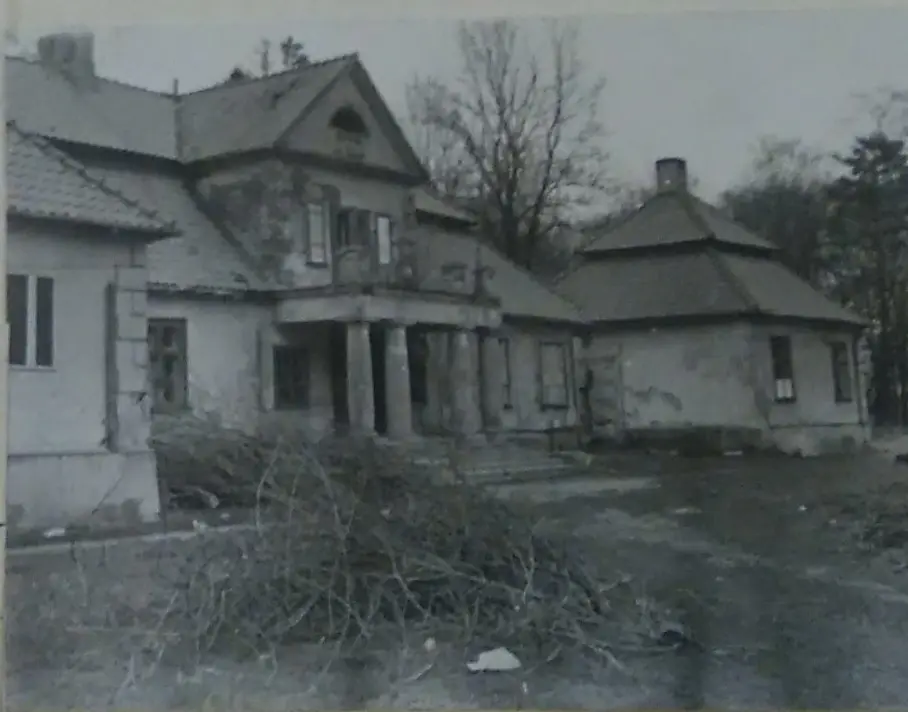
Dąbie Kujawskie - front elevation. Source: materials of the WKZ (Voivodeship Historical Monument Office) in Włocławek